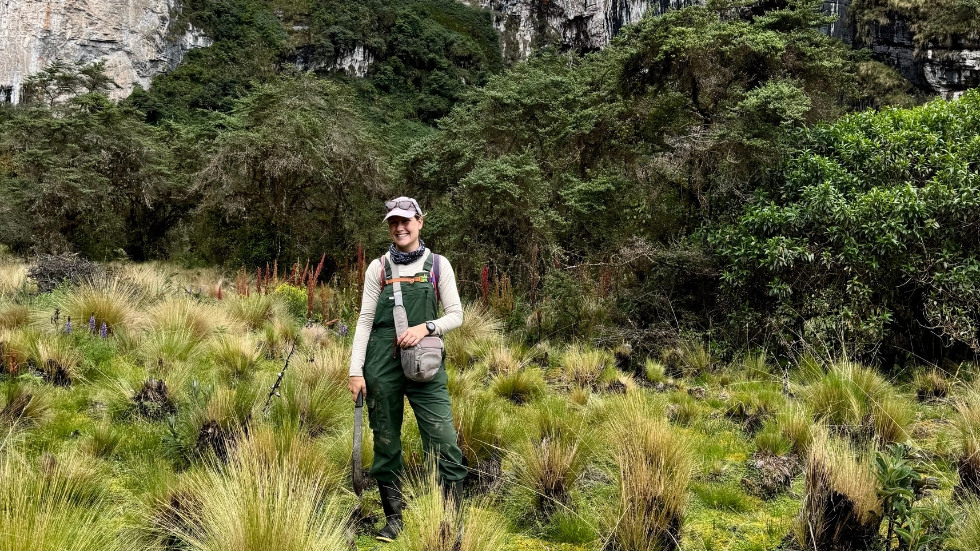
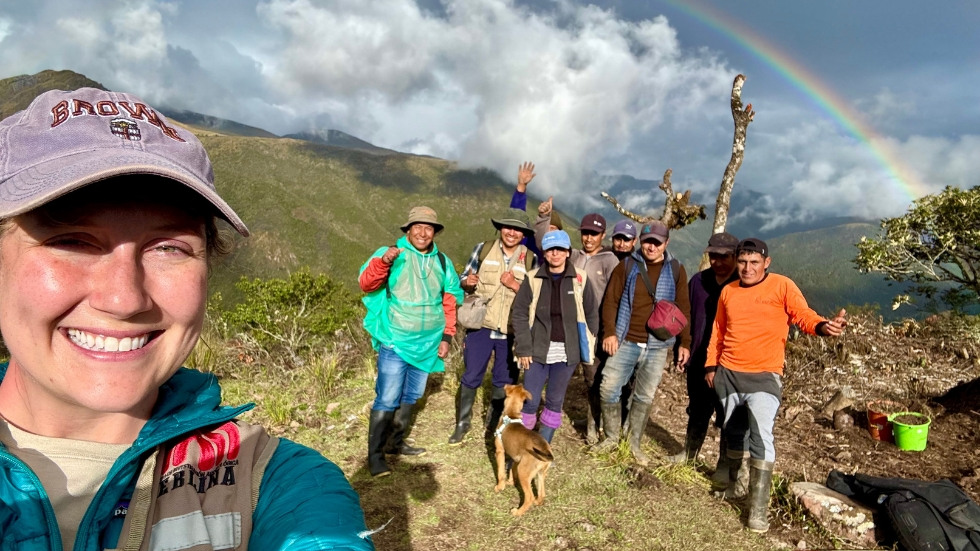
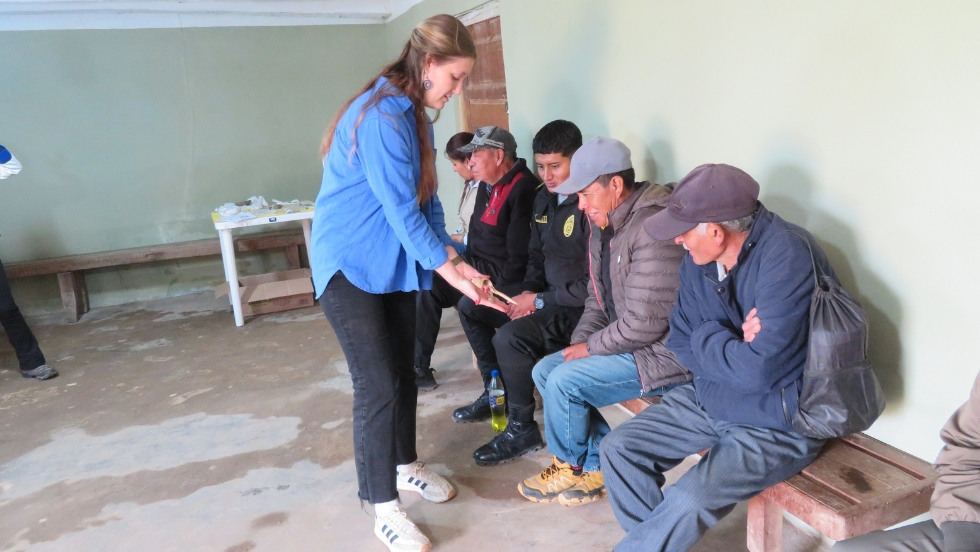
Alyssa Bolster, fourth-year graduate student and Ph.D. Candidate in Anthropology, has spent the last 6 months conducting dissertation fieldwork in Peru. As a Fulbright scholar, she spent three months in 2025 co-directing excavations with Peruvian archaeologist Natali Lopez Aldave at two sites in the Departments of La Libertad and San Martín. The archaeological sites, called El Lirio de Bolivar and the Laguna Huayabamba, date to the late Middle Horizon (ca. 800-1000 CE) and Late Intermediate Period (1000-1470 CE), and correspond to a period of sociopolitical reorganization and climate change.
As a bioarchaeologist, Alyssa is now working in the city of Chachapoyas to analyze the human remains she and her team excavated, estimating sex, age, health and more from mummy bundles, primary burials, and commingled skeletal elements. She is also collaborating with local ceramic, textile, zooarchaeology, paleobotanical and lithic specialists to analyze the other artifacts, and training 12 students from the Universidad Nacional Toribio Rodriguez de Mendoza de Amazonas (UNTRM) in laboratory techniques. Each of these students will be presenting a poster on a mini project in April in collaboration with the Instituto de Investigación de Arqueología y Antropología “Kuélap” at UNTRM, and they have been hard at work this past month crafting research questions.
Alyssa will wrap up laboratory work in April, and return to New England with small samples for stable isotope analysis, microCT imaging, and aDNA research. These analyses will be conducted in the Integrated Laboratory for Archaeological Sciences (ILAS) at Brown, and in collaboration with the Department of Ecology, Evolution and Organismal Biology and Warren Alpert Medical Center at Brown and the Department of Human Evolutionary Biology at Harvard. Alyssa recently was interviewed by the US Embassy in Peru as part of their series "Diálogos del Bicentenario," celebrating 200 years of political and scholarly collaboration between the two countries.